What Is Your Biological Age? Meet Vitall’s New Bio Age Feature

You know the age on your passport. Vitall’s new Bio Age feature gives you another way to understand how your body is functioning on the inside, using compatible biomarkers already measured in your blood test
We spend a remarkable amount of time trying to look younger from the outside. We invest in skincare, haircare, fitness, treatments and supplements, all hoping to preserve the visible signals of youth. There is nothing trivial about wanting to look well. Appearance can influence confidence and how we recognise ourselves. But the biology that shapes how well we age is not confined to the mirror.
It is also reflected in the systems regulating blood sugar, cholesterol, inflammation, blood health and the function of organs such as the liver and kidneys. Supporting these systems does more than change how ageing looks. It can support energy, resilience, physical capacity and long-term health.
That is the thinking behind Vitall’s new Bio Age feature. Available at no additional cost with eligible tests, it brings compatible blood biomarkers together to give you one accessible measure of how your current physiological profile compares with your chronological age.
What is biological age?
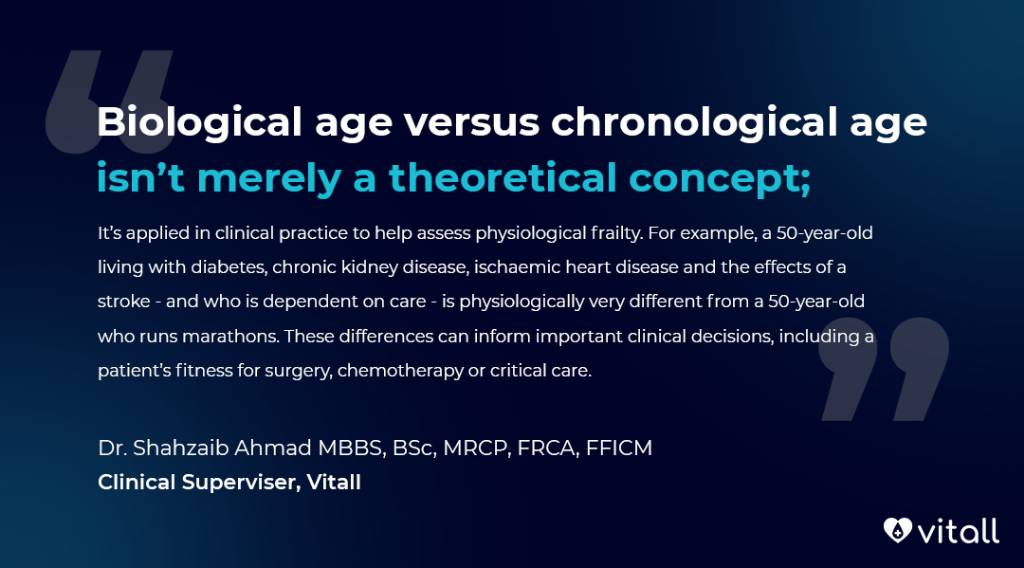
Biological age is an estimate of how old the body appears physiologically, based on measurable characteristics of its condition and function. Chronological age simply records the number of years since you were born. Biological age attempts to capture why two people with the same date of birth can have very different health profiles.
There is no single, universally accepted biological-age test. Researchers have built different “ageing clocks” using clinical blood biomarkers, physical function, medical imaging, proteins, metabolites, immune glycans, telomeres or patterns of DNA methylation. These methods are not interchangeable and may capture different aspects of ageing (Bafei et al., 2023; Moqri et al., 2023).
Vitall’s Bio Age is calculated using a multi-biomarker model informed by the Klemera-Doubal Method. The calculation compares an individual’s blood biomarker profile with age-related patterns identified in the US National Health and Nutrition Examination Survey (NHANES). Its coefficients are approximate values consistent with published NHANES models described by Levine (2013) and Kwon and Belsky (2021).
Biological age vs chronological age
Your chronological age moves at exactly the same rate as everyone else’s. Your physiology does not.
Genetics forms part of the picture, but health is also shaped by a lifetime of exposures and behaviours, including diet, physical activity, sleep, smoking, alcohol, stress, illness, medication and social and environmental conditions. Not every influence is within an individual’s control. The World Health Organization notes that healthy ageing reflects both a person’s intrinsic physical and mental capacity and the environment in which they live (WHO, 2020).
A Biological Age result therefore should not be interpreted as a moral score or a verdict on how well someone has lived. It is a data-led snapshot that can help reveal whether the biomarkers measured at that moment look more like those generally seen at a younger, similar or older chronological age.
What does Biological Age measure?
Biological Age does not directly measure the passage of time. It evaluates a pattern across compatible blood biomarkers associated with physiological function and health risk, then expresses that pattern in years.
Depending on the eligible test, the contributing information may reflect several connected areas of health, such as:
- Metabolic health: how effectively the body is regulating blood glucose over time.
- Cardiovascular health: the balance of cholesterol and other blood lipids associated with heart and vascular risk.
- Inflammation: signals linked to immune activity and systemic inflammatory burden.
- Liver function: proteins and enzymes that provide information about liver health and metabolic processing.
- Kidney function: markers associated with filtration and the removal of waste.
- Blood and immune health: characteristics of red cells, white cells and other blood components where compatible measures are included.
The final score is more useful than judging ageing from one biomarker alone because ageing is a multi-system process. An international expert consensus concluded that no single biomarker is likely to capture the heterogeneous nature of biological ageing and that composite measures are a more promising direction (Perri et al., 2025).
Test your whole body as a system to understand and master your health. This all in one health test targets male lifestyle risks to put you in control.. £299.00 Take a whole body holistic view of female health risks. This all round health test provides the reassurance needed for a healthier you!. £299.00

How is biological age calculated?
Biological-age models generally use mathematics to compare a person’s measured biology with patterns observed in a reference population. Depending on the model, the calculation may be designed to estimate chronological age, physiological dysregulation, disease risk, mortality risk or the pace of ageing. Those are related concepts, but they are not the same thing.
One influential research model, Phenotypic Age, combines chronological age with nine routine clinical biomarkers. In an independent cohort of more than 11,000 US adults, the measure was associated with disease burden and mortality after chronological age was taken into account (Liu et al., 2018). Other blood-based models use different biomarker sets and statistical methods, including regression, principal component analysis and machine learning (Bafei et al., 2023; Bortz et al., 2023).
This research supports the principle behind multi-marker biological-age estimates: routine blood data can contain information about physiological ageing that a birth date cannot. It does not mean that every biological-age model uses the same formula or produces an identical result.
What does my Bio Age result mean?
The most useful comparison is the difference between your Bio Age and your chronological age. This is sometimes called an “age gap” or “age acceleration”.
If your Bio Age is lower than your chronological age
Your measured biomarker pattern appears physiologically younger than your calendar age within the model used. This can be encouraging, but it is not immunity from disease and does not mean that every organ or biological system is younger.
If your Bio Age is similar to your chronological age
Your measured biomarker profile broadly aligns with what the model expects for someone of your age. The individual results still matter. A similar overall score can contain areas of strength as well as specific biomarkers that deserve attention.
If your Bio Age is higher than your chronological age
Your current biomarker pattern appears physiologically older than expected for your calendar age. Research on established clinical ageing clocks associates age acceleration with greater morbidity and mortality risk at a population level (Liu et al., 2018; Warner et al., 2024).
That does not mean the result diagnoses a disease, predicts how long you will live or proves that damage is permanent. A higher score is a reason to look beneath the headline: which individual biomarkers are contributing, whether the result could have been affected by a temporary factor, and what should be discussed with a qualified healthcare professional.
Why is Bio Age useful as an overall health measure?
Health results are usually delivered as a long list of separate numbers. Each can be clinically meaningful, but the whole report can be difficult to interpret at a glance. Bio Age gives that information an intuitive frame.
It is useful because it:
- Makes multi-system data easier to understand. Age is a familiar unit, so it can help people grasp the combined signal across several biomarkers.
- Adds context to chronological age. It recognises that people of the same age can differ substantially in physiological condition and health risk.
- Encourages people to look beyond one marker. Cholesterol, blood sugar, inflammation and organ function interact; overall health is not decided by a single “good” result.
- Creates a memorable baseline. A first measurement provides a reference point before changes to diet, activity, sleep or clinically recommended treatment.
- Can support tracking over time. Repeated measurements, taken under reasonably consistent conditions, can help show whether the overall pattern is moving in a favourable direction.
The score should always be read with the detailed biomarker results. Think of Bio Age as the front cover of your health story, not every page.
Can you reduce your biological age?
The most scientifically accurate answer is: the biomarkers contributing to some biological-age measures can change, but claims about “reversing ageing” should be treated cautiously.
Different clocks respond differently to the same intervention. In the two-year CALERIE randomised trial, calorie restriction modestly slowed one DNA-methylation measure of the pace of ageing but did not significantly change several age-estimate clocks (Waziry et al., 2023). In the three-year DO-HEALTH trial of adults aged 70 and over, omega-3 supplementation produced small changes across several epigenetic clocks, with additional effects from vitamin D and exercise on one measure; the researchers stressed that the long-term clinical significance remains uncertain (Bischoff-Ferrari et al., 2025).
These were epigenetic measures, not Vitall’s blood-biomarker feature, so their numerical effects cannot be transferred directly to your Bio Age result. The sensible aim is not to chase a dramatic number. It is to improve the modifiable health markers and behaviours that the number helps bring into view.
How can I support a healthier Bio Age?
1. Start with the biomarkers, not a generic “anti-ageing” routine
Open the detailed report and identify which results are outside range, borderline or changing unfavourably. The right next step for raised HbA1c is not automatically the right next step for low ferritin, altered thyroid markers or an abnormal liver result. Speak to a qualified healthcare professional about abnormal results, symptoms, medication and personal risk.
2. Build both aerobic fitness and strength
Physical activity supports cardiovascular, metabolic and musculoskeletal health. UK guidance recommends at least 150 minutes of moderate activity or 75 minutes of vigorous activity each week, alongside strengthening work for the major muscle groups on at least two days (NHS, 2022a). Breaking up long periods of sitting matters too.
3. Eat for metabolic and cardiovascular health
Prioritise a sustainable dietary pattern rich in vegetables, fruit, beans and pulses, higher-fibre carbohydrates and appropriate sources of protein and unsaturated fats. The NHS Eatwell Guide recommends looking at balance across the day or week rather than demanding perfection at every meal (NHS, 2022b).
4. Protect sleep and recovery
Most adults need around seven to nine hours of sleep, although individual needs differ (NHS, 2023a). Persistent poor sleep can also be a symptom worth investigating rather than simply a failure of discipline.
5. Do not smoke
Smoking affects cardiovascular, respiratory and inflammatory biology and remains one of the clearest modifiable threats to healthy lifespan. If you smoke, evidence-based stop-smoking support is more valuable than any “longevity” supplement stack.
6. Keep alcohol risk low
There is no completely safe level of alcohol consumption. UK guidance advises men and women who drink regularly not to exceed 14 units a week, spread across three or more days, with drink-free days where possible (NHS, 2023b).
7. Treat deficiencies and conditions appropriately
Do not self-prescribe high-dose supplements to force a number down. If testing identifies a deficiency, metabolic concern or abnormal organ-function marker, the safest and most effective response depends on its cause. Use the result to support an informed conversation with a healthcare professional.
8. Retest for direction, not daily reassurance
Bio Age is better suited to periodic tracking than constant checking. Allow enough time for a meaningful intervention to influence the relevant biomarkers and try to repeat testing under similar conditions. The trend and the individual markers are usually more informative than a small movement in one isolated score.
Can Bio Age change from one test to another?
Yes. Some blood biomarkers can shift with illness, inflammation, hydration, fasting status, alcohol intake, strenuous exercise, medication, menstrual or hormonal factors and laboratory variation. A change in Bio Age may reflect a genuine change in physiology, short-term conditions or both.
For the fairest comparison:
- follow the preparation instructions for each test;
- use the same collection conditions where practical;
- avoid comparing results taken during an acute illness with a well baseline;
- focus on meaningful trends rather than a one-year fluctuation;
- review the individual biomarkers alongside the headline score.
Is biological age the same as cellular age?
Not necessarily. “Biological age” is an umbrella term, not one universal laboratory measurement. Vitall’s feature is calculated from compatible blood biomarkers. It does not directly measure the age of every cell and should not be described as a DNA-methylation, telomere or epigenetic test unless those methods are actually performed.
Is Bio Age a diagnosis?
No. Bio Age is a health-information feature. It cannot diagnose a condition, replace a clinical assessment or predict an individual lifespan. Results should be considered alongside symptoms, medical history, medicines and the individual biomarker values. If you are concerned about a result or your health, speak to a qualified healthcare professional. For urgent concerns, contact NHS 111, your GP or call 999 in an emergency.
Which Vitall tests include Bio Age?
Bio Age is included free with eligible Vitall tests, including:
Test your whole body as a system to understand and master your health. This all in one health test targets male lifestyle risks to put you in control..
£299.00
Add to Cart ›
Take a whole body holistic view of female health risks. This all round health test provides the reassurance needed for a healthier you!.
£299.00
Add to Cart ›The outside reflects only part of the story
There is no shame in wanting to look younger. But a smoother surface cannot tell you how well your body is regulating glucose, transporting cholesterol, responding to inflammation or maintaining organ function.
Healthy ageing is not about pretending time has stopped. It is about protecting the physical and mental capacity that allows you to keep doing what matters. A Bio Age result makes that idea tangible: one accessible starting point, backed by the blood biomarkers beneath it.
Your birthday is fixed. Your next health decision is not.
Take an eligible Vitall health check and receive your Bio Age at no additional cost.
Quick-answer FAQ copy
What exactly is Bio Age?
Bio Age is an estimate of how old your body appears physiologically based on a combination of compatible blood biomarkers. It provides a different perspective from chronological age, which simply counts the years since birth.
What does Bio Age take into account?
Vitall’s feature brings together compatible biomarkers from eligible tests to reflect several areas of physiological health. The precise inputs depend on the approved calculation and panel. Always interpret the score alongside the individual blood results.
What does a high Bio Age mean?
A Bio Age above your chronological age means your current biomarker pattern appears physiologically older than expected within the model. It is not a diagnosis or lifespan prediction. Review the contributing results and speak to a healthcare professional about abnormalities or concerns.
Is a low Bio Age always good?
It is generally an encouraging signal within the model, but it does not guarantee that every organ is healthy or remove the need to consider individual results, symptoms and risk factors.
Can I lower my Bio Age?
The biomarkers contributing to Bio Age can change. Focus on the specific results that need attention and on evidence-based habits such as regular activity, a balanced diet, sufficient sleep, not smoking and keeping alcohol risk low. Treat medical issues and deficiencies with appropriate professional guidance.
How often should I check my Bio Age?
Use it as a periodic baseline and tracking measure rather than a number to check constantly. The appropriate interval depends on the biomarkers involved, any treatment or lifestyle change and advice from your healthcare professional.
Is Bio Age the same as an epigenetic age test?
No. Vitall’s feature uses compatible blood biomarkers. Epigenetic clocks measure patterns such as DNA methylation. They are different methods and their results are not interchangeable.
Does Bio Age tell me how long I will live?
No. Research ageing clocks can be associated with health and mortality risk across populations, but an individual Bio Age result cannot predict lifespan.
Get Yourself Tested With Vitall's Home Test Kits





Clinical review

Dr. Shahzaib Ahmad MBBS, BSc, MRCP, FRCA, FFICM
Clinical Supervisor - Vitall|GMC 7495062|Profile
Reviewed on 20/08/2026
Next review due 20/08/2027
Review focus: Blood biomarkers, laboratory testing methodology, and biochemical interpretation.
More Articles in These Categories
Similar Articles
View all articles ›How Can I Keep My Liver Healthy?
The Importance of a Health MOT
The Importance of Doing Regular Check Ups
Benefits Of Having General Health Check-Ups
Preparing For A General Health Check-Up: What to Expect?
Mastering Magnesium: Balance Your Diet for Better Health
Revolutionary Type 1 Diabetes Risk Screening Study Begins Participant Enrollment for the First Time Globally
Is Your Food Allergy Raising Your Heart Disease Death Risk? New Study Reveals Startling Connection
When Your Physician Recommends a Medical Scan: Understanding the Advantages and Necessary Precautions
Widespread Support for 'Patient Passports': A Revolutionary Approach to Sharing Medical Records with Doctors
References & Citations For What Is Your Biological Age? Meet Vitall’s New Bio Age Feature
Bafei, S.E.C., Shen, C. and Quach, A. (2023) ‘Biomarkers selection and mathematical modeling in biological age estimation’, npj Aging, 9, 13. https://doi.org/10.1038/s41514-023-00110-8
Bischoff-Ferrari, H.A. et al. (2025) ‘Individual and additive effects of vitamin D, omega-3 and exercise on DNA methylation clocks of biological aging in older adults from the DO-HEALTH trial’, Nature Aging, 5, pp. 376–385. https://doi.org/10.1038/s43587-024-00793-y
Bortz, J. et al. (2023) ‘Biological age estimation using circulating blood biomarkers’, Communications Biology, 6, 1089. https://doi.org/10.1038/s42003-023-05456-z
Kwon, D. and Belsky, D.W. (2021) ‘A toolkit for quantification of biological age from blood chemistry and organ function test data: BioAge’, GeroScience, 43(6), pp. 2795–2808. https://doi.org/10.1007/s11357-021-00480-5
Levine, M.E. et al. (2018) ‘An epigenetic biomarker of aging for lifespan and healthspan’, Aging, 10(4), pp. 573–591. https://doi.org/10.18632/aging.101414
Levine, M.E. (2013) ‘Modeling the rate of senescence: Can estimated biological age predict mortality more accurately than chronological age?’, The Journals of Gerontology: Series A, 68(6), pp. 667–674. https://doi.org/10.1093/gerona/gls233
Liu, Z. et al. (2018) ‘A new aging measure captures morbidity and mortality risk across diverse subpopulations from NHANES IV: A cohort study’, PLOS Medicine, 15(12), e1002718. https://doi.org/10.1371/journal.pmed.1002718
Moqri, M. et al. (2023) ‘Biomarkers of aging for the identification and evaluation of longevity interventions’, Cell, 186(18), pp. 3758–3775. https://doi.org/10.1016/j.cell.2023.08.003
NHS (2022a) ‘Physical activity guidelines for adults aged 19 to 64’. Available at: https://www.nhs.uk/live-well/exercise/physical-activity-guidelines-for-adults-aged-19-to-64/ (Accessed: 27 July 2026).
NHS (2022b) ‘The Eatwell Guide’. Available at: https://www.nhs.uk/live-well/eat-well/food-guidelines-and-food-labels/the-eatwell-guide/ (Accessed: 27 July 2026).
NHS (2023a) ‘Insomnia’. Available at: https://www.nhs.uk/conditions/insomnia/ (Accessed: 27 July 2026).
NHS (2023b) ‘Alcohol units’. Available at: https://www.nhs.uk/live-well/alcohol-advice/calculating-alcohol-units/ (Accessed: 27 July 2026).
Perri, G. et al. (2025) ‘Expert consensus statement on biomarkers of aging for use in intervention studies’, The Journals of Gerontology: Series A, 80(5), glae297. https://doi.org/10.1093/gerona/glae297
Warner, B., Ratner, E., Datta, A. and Lendasse, A. (2024) ‘A systematic review of phenotypic and epigenetic clocks used for aging and mortality quantification in humans’, Aging, 16(17), pp. 12414–12427. https://doi.org/10.18632/aging.206098
Waziry, R. et al. (2023) ‘Effect of long-term caloric restriction on DNA methylation measures of biological aging in healthy adults from the CALERIE trial’, Nature Aging, 3, pp. 248–257. https://doi.org/10.1038/s43587-022-00357-y
World Health Organization (WHO) (2020) ‘Healthy ageing and functional ability’. Available at: https://www.who.int/news-room/questions-and-answers/item/healthy-ageing-and-functional-ability (Accessed: 27 July 2026).
